

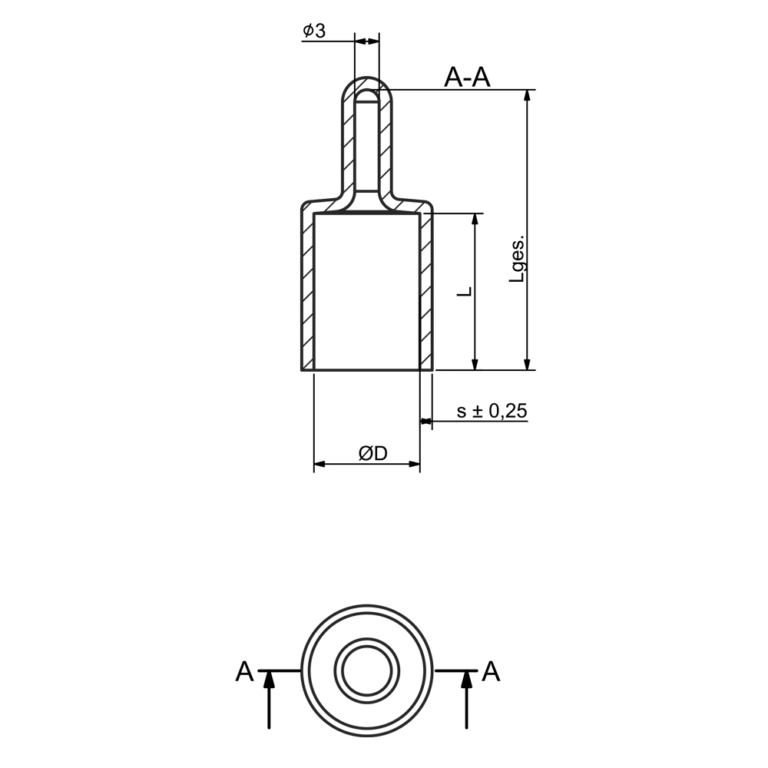
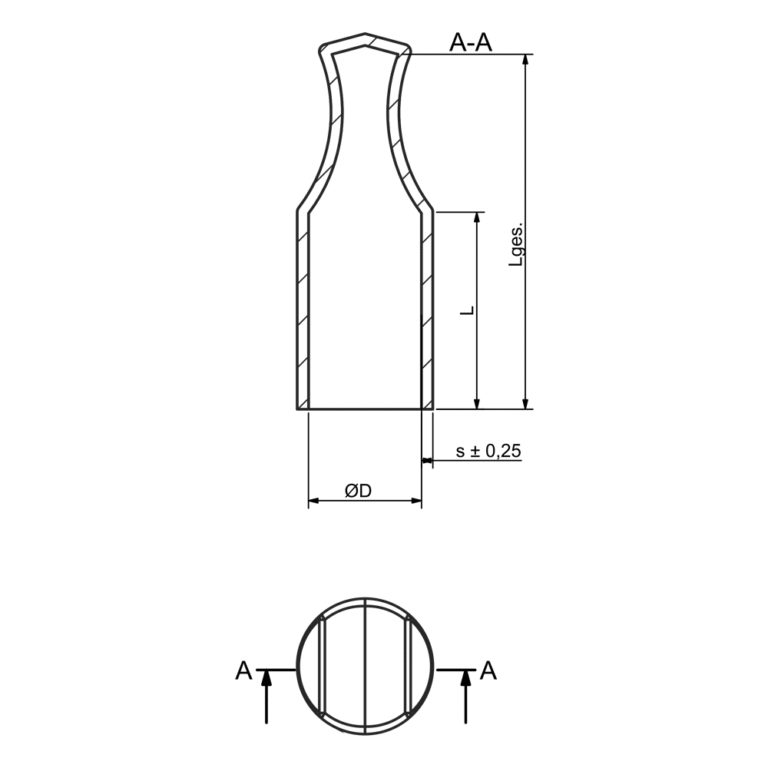
Caps with a pull-off tab are a Further development the standardised Round caps. They are used when, in addition to simple and tamper-proof installation, a Very quick disassembly plays an important role in the finishing process. For example, caps with a pull-off tab in the Automotive industry ensures that a large number of caps used as sealing caps for pipework systems can be removed manually without jeopardising compliance with the specified cycle times.
Through the non-slip geometry of the pull tab the cap compared to the standard round cap can be with one handle can be removed reliably and in significantly less time. Depending on the application, the Wide design the pull tab or the Round shape of the pull tab be the more appropriate design in each case.
The caps with pull-off tab are made from a very flexible, approx. 68 Shore A soft PVC from the Covytec material series. Thanks to the universal material properties, the caps are very versatile and adapt perfectly to the contour of a round component to be protected. However, the caps can also be used to protect oval or even square component cross-sections if dust-tightness is not required.
 Typically, caps with pull-off tabs are used as end caps or sealing caps for round pipes, pipe or hose line systems.
If, for structural reasons, the PVC caps become loose when they are removed Vacuum form the Dismantling complicated, a Hole punching in the head area of the cap Remedy.
The production of round caps with a pull-off tab using the dipping process is very interesting from an economic point of view because, in contrast to Caps with pull-off tabs made of TPE, manufactured using injection moulding Only simple and therefore cost-effective dipping moulds are available for production. The dipping moulds are heated in an oven and dipped into a bath of liquid PVC. When the hot moulding tool comes into contact with the PVC paste, also known as plastisol, a thin skin forms on the outer contour of the shaping cores, which forms the desired wall thickness of the corner caps by the end of a defined dwell time in the dipping bath.
 The wall thickness to be achieved depends on the temperature of the mould, the dwell time of the mould in the dip tank and the viscosity of the PVC material. The usable height of the protective caps is controlled by the immersion depth of the right-angled mould cores.
After removing the dipping mould from the dipping bath, the excess PVC material runs and drips off, whereby flow marks and drop formation at the closed end of the rectangular caps cannot be avoided.
Finally, the multi-cavity mould with the PVC layer is heated again in order to achieve the rubber-elastic properties of the PVC material in accordance with the data sheet. This work step is often referred to as gelling.
After cooling, the caps with the pull-off tab are removed from the cores manually using an auxiliary tool.
You are currently viewing a placeholder content from Vimeo. To access the actual content, click the button below. Please note that doing so will share data with third-party providers.
More InformationYou are currently viewing a placeholder content from YouTube. To access the actual content, click the button below. Please note that doing so will share data with third-party providers.
More InformationYou need to load content from reCAPTCHA to submit the form. Please note that doing so will share data with third-party providers.
More Information
