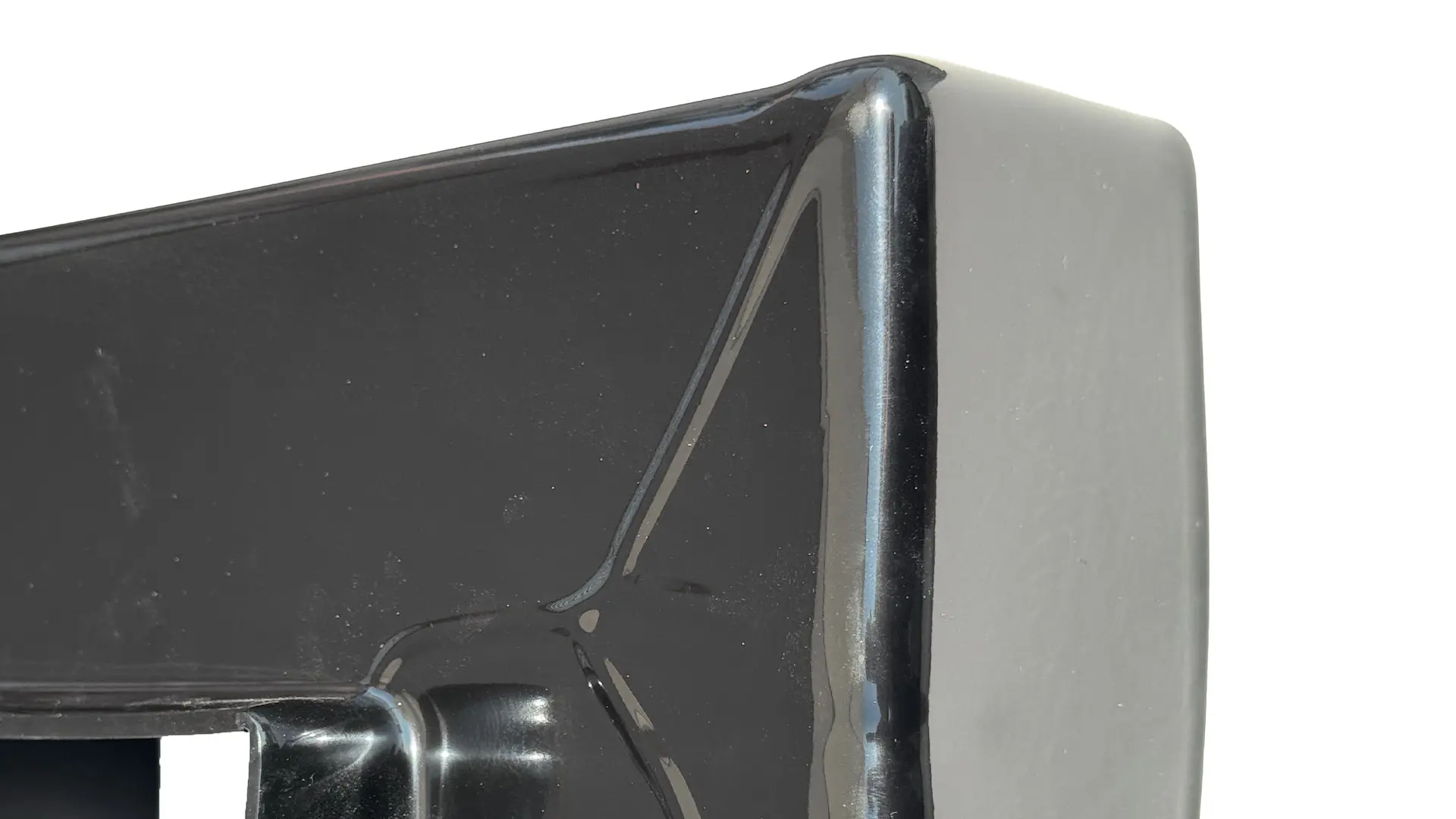
When selecting dip-moulded soft PVC protective caps, functionality and cost-effectiveness are the key considerations. Appearance often plays a role too, as all dip-moulded parts have a glossy finish. Time and again, new customers ask us why we point out on our website and in our quotations that some drainage marks are unavoidable, and that these do not constitute a quality defect in the dip-moulding process.
The short answer is: flow marks are an inherent characteristic of the dip-coating process using viscous plastisol. They do not affect the function or quality of the protective cap, which is normally fitted over the component to be protected. Below, we explain how these marks arise and why they due to the geometry are technically unavoidable and how HAMCO deals with them constructively.
How do wear marks form?
Diving caps are used in the Immersion process manufactured. To put it very simply, a hot dip mould is immersed in a viscous plastic and withdrawn again after a short while. Whilst immersed, PVC adheres to the hot wall of the mould and, over time, forms the wall thickness of the moulded part. As the dip mould is withdrawn from the dip bath, excess material flows down the outer surface under the influence of gravity to the lowest point, where it drips off. In the case of non-symmetrical geometries, the viscous paste runs off unevenly. A so-called ‘drainage trail’ forms, primarily at points where there is increased drainage.
This mark is inherent to the process and cannot be completely avoided with this manufacturing method, although we are exploring every possible option to minimise the process mark or position it in a specific location.
The key point is that the wear groove does not affect the protective function, the precise fit of the inner contour or the durability of the dip cap.
A purely visual characteristic with no functional implications
Discharge marks are therefore purely a visual feature which might only be relevant for dip-coated parts if they are used in visible areas and constitute a key selling point. The mechanical properties of the dip-coated cap remain virtually unchanged. The minimum material thickness continues to meet the specified requirements, and the protective effect against dirt, moisture or mechanical stresses is not compromised.
For design engineers, this means that a flow mark is not a quality defect, but rather a characteristic feature of the manufacturing process.
Precise positioning of the drainage channel
Even during the development of a component, it is possible to take into account where a flow mark might later become visible. HAMCO attaches great importance to relocating these marks, where possible, to areas that are of little functional or visual significance.
A good example is hand grips for wheelchairs: these are coated using a dip-coating process to achieve a non-slip and durable surface.
The grip ring has an outer section, which is constantly gripped by the user’s fingers, and an inner ring section. By ensuring the correct alignment during the dip-coating process, the flow mark is precisely positioned on the inside of the grip ring, which has been coated using this method. This results in a uniform flow mark, significantly reduced in size, outside the actual grip area. The user does not come into contact with this area during normal use, whilst the function and ergonomics are fully preserved.
This example shows that flow lines can be taken into account as early as the process planning stage in order to optimise the visual appearance as well.
Specific geometries promote the formation of skid marks
The formation of a flow mark depends not only on the process, but also on the geometry of the component.
They may be particularly noticeable in the following areas:
- complex contours
- Areas with obtuse-angled transitions between materials
Unlike on seamless symmetrical surfaces, the liquid material either accumulates or spreads out here during the dipping process.
Comparison with injection-moulded parts
Other plastics manufacturing processes also leave visible marks.
In the case of injection-moulded parts, for example, the following characteristics are typical of the standard production process:
- Sprue points
- Expansion joints
- Ejector marks
These characteristics are taken into account in the design and do not constitute a quality defect provided they are technically sound. The same applies to flow marks on immersion caps. They are a characteristic feature of the respective manufacturing process and cannot be completely avoided, even with many years’ experience.