Plastics recycling does not begin only at the end of a component’s life cycle. Production waste is generated as early as the manufacturing stage, and under the right conditions, this can be reused as raw material.
With the HAMCO process, production waste from various PVC processing methods can be returned to a common material cycle. After being ground down, the recovered PVC can be reused in the injection moulding process to produce suitable components.
Production offcuts are not automatically waste
At HAMCO, several PVC processing operations generate production off-cuts that can be reused. The vast majority of the materials returned for this purpose come from the Immersion process. These include, for example, surplus or unusable stamped parts, as well as scraps from punching operations. In the PVC coating process Trimmings can be used. When Injection moulding process During the processing of PVC, waste parts, start-up pieces and sprues, amongst other things, are produced, which can be used for recycling.
A key advantage of these production by-products is that their origin is known. Unlike with many post-consumer recycled materials, it is clear which materials have been processed and from which manufacturing process the residues originate.
The key factor is the degree of hardness
The degree of hardness of the material is crucial for the joint reuse of PVC production offcuts. Production offcuts from different PVC materials can be ground together provided they have the same degree of hardness.
This also makes it possible to combine PVC production offcuts of different colours and formulations. The original shape of the component, the PVC material used and the manufacturing process from which the offcut originates no longer play a decisive role in further processing.
From production offcuts to regrind for injection moulding
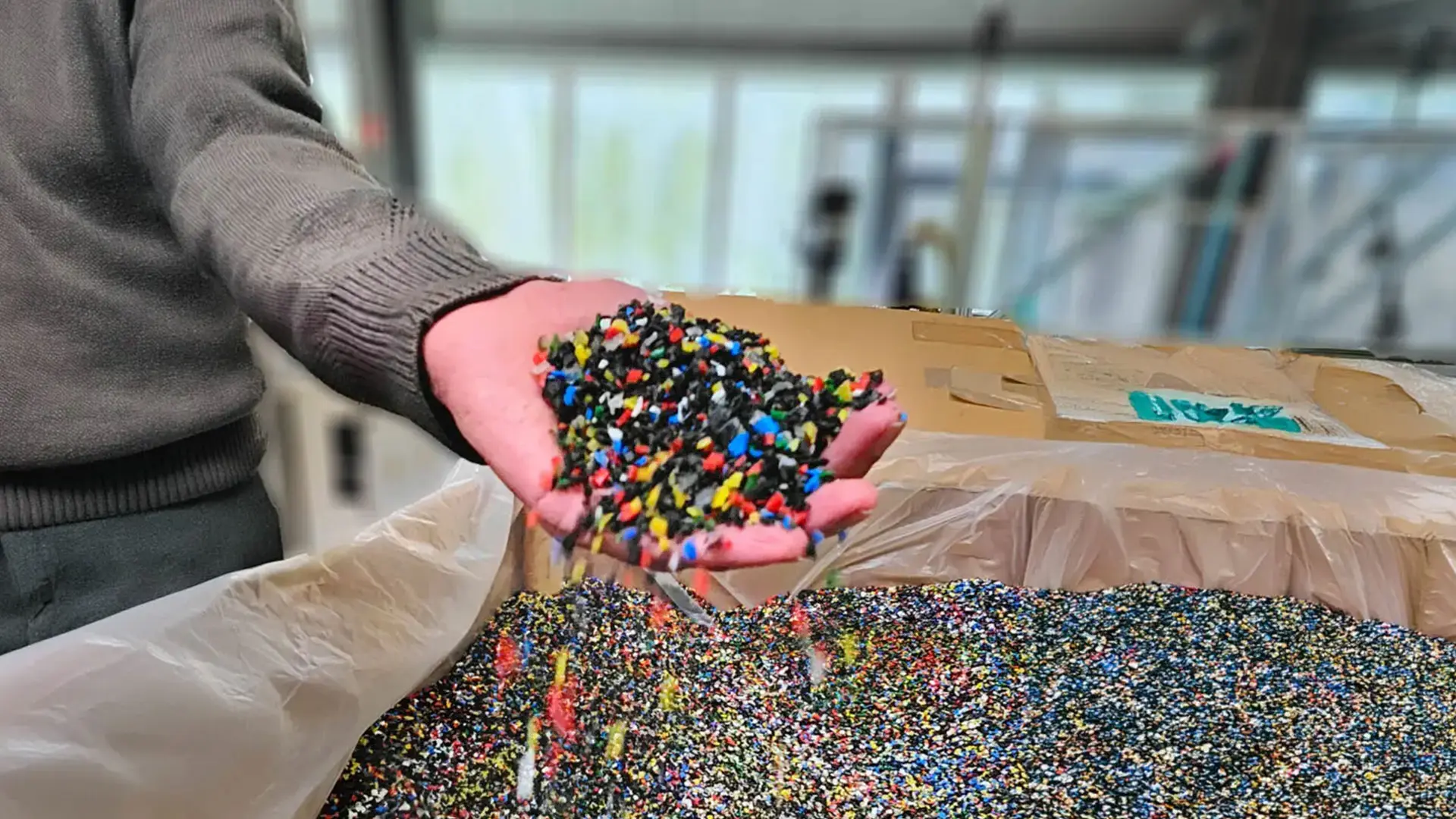
The PVC production offcuts, sorted by hardness, are ground down. This produces a ground material which is then processed exclusively using the injection moulding process.
Regranulation is not necessary for this. The ground material can be used directly as raw material for suitable injection-moulded parts.
The one-off preliminary processing of the PVC and the subsequent grinding do not result in any loss of quality in the material. The ground material may also contain production residues from Covytec® materials may include those that were originally designed to meet specific requirements.
It is not possible to recycle the ground material back into the dip-coating or coating process, as both processes use liquid PVC plastisol.
When it comes to colour, the main thing is that it’s black
Sorting production offcuts by colour would involve additional effort and would hardly make economic sense. PVC production offcuts of different colours are therefore ground up together.
Even small amounts of black material residue are enough to mask the other colours. The mixed regrind is thus used to produce jet-black injection-moulded parts – without the need for additional colouring.
New components made from PVC regrind
A practical example of the reuse of PVC regrind is injection-moulded handles made from soft PVC. Following consultation with the customer, HAMCO can manufacture the desired handle design using 100 per cent regrind.
Recycled material can also be used in other injection-moulded parts, provided the requirements of the respective component allow for this. This means that, for suitable applications, HAMCO can also accommodate customer-specified recycled content requirements.