
Compression set

That really takes the biscuit! Our sofa used to be absolutely lovely. The seat was firm, the cushions high and completely wrinkle-free. Then we sat on it for a few minutes, thinking about the creep behaviour of plastics. Afterwards, the sofa looked just as it did in the catalogue. After a few years, our sofa had become quite […]
Excess material on dip-coated parts

Plastisol, too, has its sheltered corners. Everyone is familiar with snow drifts. Although the same amount of snow falls all round, small mounds form in some places, whilst in others only a thin layer of snow remains. The wind distributes the snow behind the house and under the canopy differently to how it does in open terrain. Liquid PVC also accumulates during production […]
Wall thickness distribution in dip-coated parts

Even a pancake isn’t the same thickness all over. Imagine you’re pouring pancake batter into a hot frying pan. No matter how you go about it, the batter can’t cover the whole surface of the pan at the same time, so it won’t be an even thickness. Some areas will be slightly thicker, others slightly thinner – simply because the […]
Drain marks and drain drops
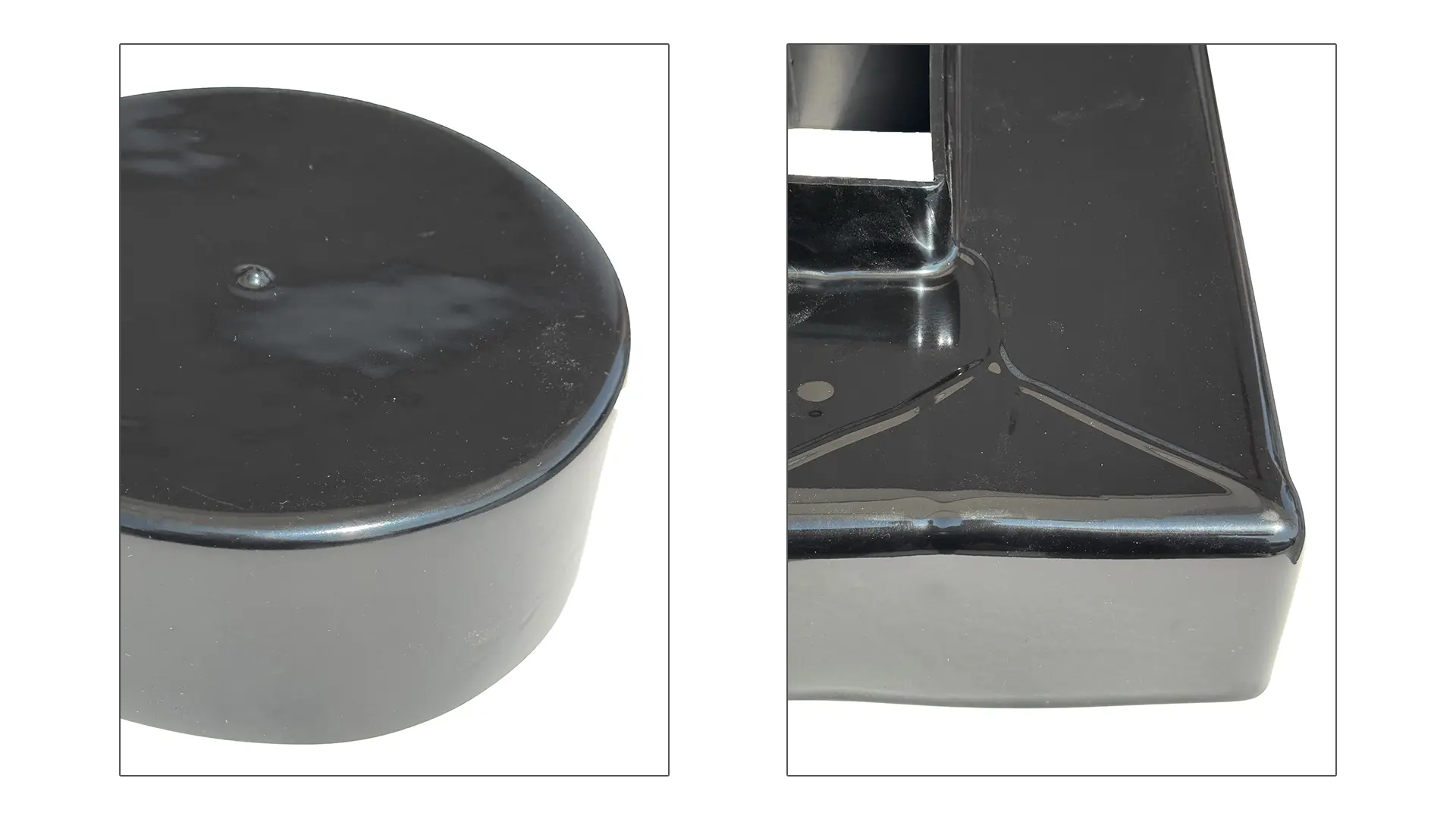
The honey has shown us how it’s done. Have you ever taken a spoon standing upright in a jar of honey out of the jar? At first, the honey clings evenly to the spoon. But after just a few seconds, it begins to flow slowly downwards. This creates fine streaks, and the famous last drop eventually collects at the lowest point. It’s exactly the same with […]
Creeper behaviour
‘Anyone who knows plastics goes for cement.’ A professor of plastics engineering at what was then Darmstadt University of Applied Sciences is said to have once uttered this phrase. Of course, it was meant tongue-in-cheek. Because anyone who really knows plastics knows that they are fantastic materials – you just have to understand their peculiarities. And one of these is called creep. What does creep actually mean? Let’s take a look […]
Frozen tensions
Before the trouser button pops off, imagine you’re putting on that suit again for the first time in ages – the one you last wore to a wedding. You realise the trousers used to be a bit looser, but buying a new suit just isn’t an option for you. You suck in your stomach a little, fasten your trousers […]
Stress cracking
Constant stress is rarely a good thing. Some of us are familiar with this: lots to do, far too much to do, constant stress, a never-ending stream of issues and new deadlines – you’re busy and active, but essentially not making any progress. You keep up appearances in front of your colleagues. „Everything’s fine, everything’s OK.“ But then, at some point, the moment comes when you start to feel the weight of […]
Silverfish (stress cracks)
There’s only one solution: heat rather than chemicals. Those nimble little silverfish in the bathroom are not a sign of poor hygiene. Rather, they are an indicator of a warm, damp microclimate. A single silverfish is therefore usually harmless, but a mass infestation serves as a warning sign of damp damage, mould or structural defects. This is particularly true of transparent plastics such as PMMA (as […]
Plastic soul
The liquid centre beneath the skin of cherry tomatoes on a pizza should be treated with caution. Even if the pizza seems to have cooled down a little, you can still burn your tongue quite badly on the lava-like centre of the cherry tomato. A plastic moulded part that has just been removed from its mould behaves in much the same way. Beneath the cooled outer layer of the moulded part, there still lies […]
Back pressure, holding pressure, holding pressure
Without pressure, absolutely nothing happens! We’ve all been there. Homework, tax returns, ironing the washing… As long as there’s no pressure, nothing gets done for ages! It’s much the same in injection moulding – without pressure, hot plastic won’t turn into a finished moulded part. Back pressure – the internal pressure builds up. You know, there’s that one […]
Rheology
Morning grouch vs. party volcano At low temperatures, plastics are stiff and sluggish - like a person shortly after waking up and without coffee. As the temperature rises, movement comes into play - the party can soon begin. The plastic pellets melt inside the heated injection moulding cylinder and become increasingly mobile due to the rotary movement of the screw and [...]
Thixotropy
Movement makes wallpaper paste and ketchup thin - two typically thixotropic liquids. If you leave them alone, they are immobile and sluggish. Only movement, such as stirring the paste in the bucket or shaking the ketchup bottle, changes their almost human characteristics. The wallpaper paste can be effortlessly applied to the wallpaper by moving the brush [...]
Hose core
True beauty comes from within „True beauty comes from within“. In a slightly modified form, this saying served as an advertising slogan in the 1970s and 1980s for a manufacturer of dietary supplements and cosmetics, which extolled the virtues of natural beauty that comes from within. The term ‘hose lining’, which refers to the material that forms the inner surface of a plastic or rubber hose […]
Frictional heat
Some like it hot! Why do we rub our hands together vigorously in winter when our fingers are cold? Because rapid rubbing converts kinetic energy into heat. And it is precisely this physical phenomenon that is utilised in multiple ways in plastics processing, specifically in the injection moulding process. We recall from the explanation of the concept of rheology that the […]